

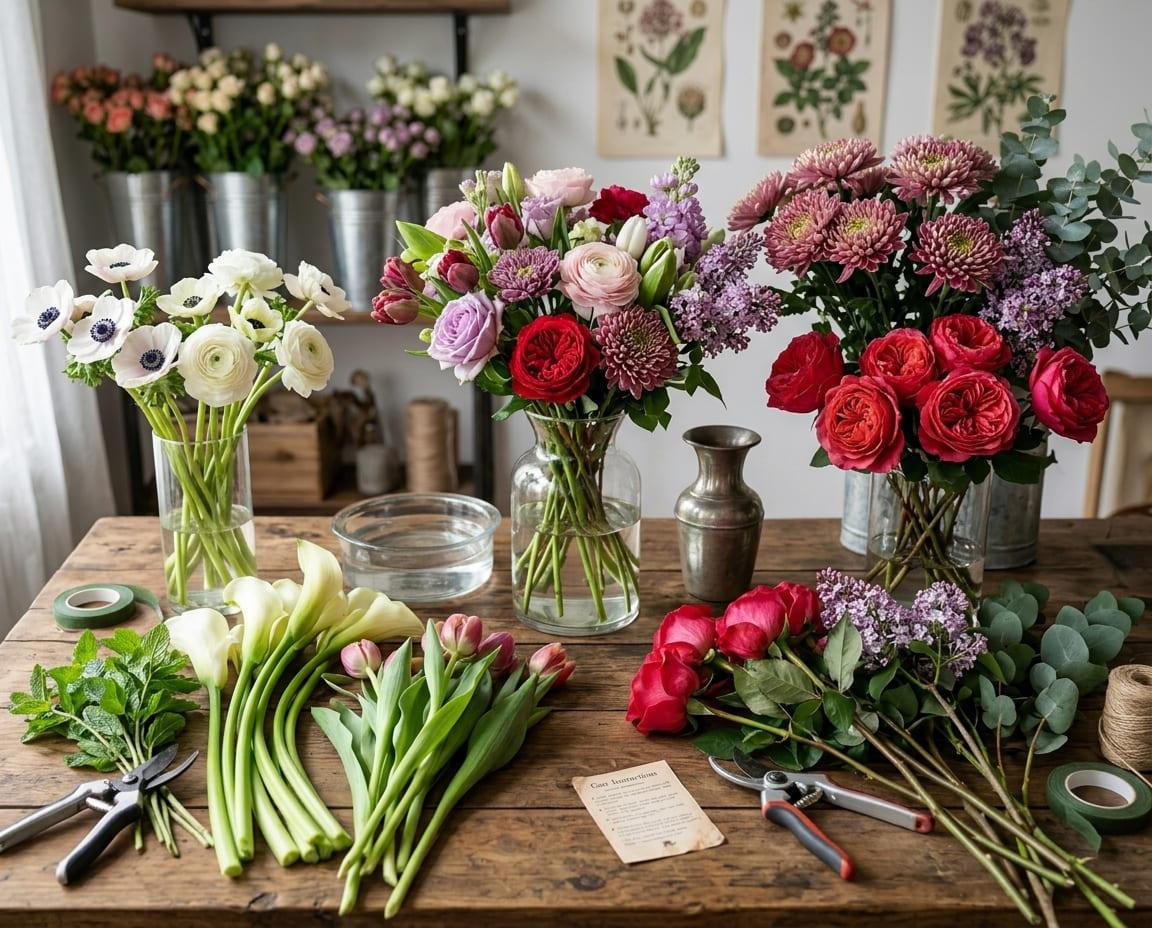
After delivery, a bouquet needs a clean vase, fresh water and a newly cut stem base. A common question is whether flowers should be cut straight across or at an angle. For most cut flowers, a clean angled cut is a practical choice; the sharpness of the tool and avoiding crushed tissue matter more than the exact angle.
In short: trim about 1–2 cm from most stems with a clean, sharp knife or secateurs, making a smooth angled cut without ragged edges. A straight cut is not a mandatory rule for tulips or every soft stem. Follow your florist's instructions when a bouquet contains flowers with special requirements.
Why should flower stems be recut?
The stem end starts to dry during transport, while damaged tissue and bacteria can reduce water uptake. A fresh cut exposes a clean surface. An angled cut also helps prevent the entire base of the stem from sitting flat against the bottom of the vase.
You do not need to shape the stem into a long point. One firm, clean cut is enough. A blunt tool can crush the water-conducting tissue even when the result looks tidy from the outside.
Straight or angled cut: the useful rule
The general recommendation for cut flowers is a clean angled cut made with a sharp tool. There is no universal, reliable division where every soft stem must be cut straight and every firm stem at precisely 45 degrees. The variety, condition of the stem and your florist's instructions can affect preparation.
Roses, chrysanthemums, lisianthus, alstroemeria, carnations and most flowers in a mixed bouquet can receive a simple angled cut. Tulips and gerberas have soft stems that need gentle handling and support from a suitable vase; a clean cut matters more than a rigid choice between straight and angled.
Quick guide by stem type
| Flower or stem type | What to do at home | What to avoid |
|---|---|---|
| Roses, lisianthus, alstroemeria, carnations | Make a clean angled cut of about 1–2 cm | Blunt scissors and crushed edges |
| Chrysanthemums and other firm stems | Use a sharp knife or clean secateurs | Breaking or crushing the stem base |
| Tulips and gerberas with soft stems | Cut cleanly and place in a supportive vase | Compressing the stem or using a vase that is too short |
| Branches and woody stems | Use clean secateurs and follow the florist's advice | Hammering or crushing the base |
| Hollow stems and unusual flowers | Follow species-specific instructions | Aggressive experiments that split the stem |
| Flowers in a box or basket with floral foam | Keep the foam moist as instructed | Removing flowers only to recut them |
How to recut a bouquet at home
- Wash the vase with detergent and rinse it thoroughly.
- Use a sharp knife or clean secateurs.
- Remove leaves and other plant material that would sit below the waterline.
- Trim about 1–2 cm from each stem in one firm movement without crushing it.
- Place the flowers in fresh water immediately and mix flower food according to the packet instructions if it was supplied.
Cutting stems underwater is not essential. Clean handling and placing the flowers promptly in the vase after cutting are more important.
Which tool should you use?
A sharp florist's knife produces a clean cut, but use one only if you can handle it safely. Well-sharpened secateurs are a convenient option for most customers. Ordinary kitchen scissors can compress thicker stems when their blades are not sharp enough.
Clean the tool before use. Plant residue from previous trimming can contaminate the newly exposed stem surface.
How much water and which vase?
The vase should be stable and tall enough to support the stems. This is particularly helpful for tulips and gerberas, which can bend. Water levels and care may vary with the arrangement, so follow any instructions supplied with the bouquet.
Check the water regularly. If it becomes cloudy, wash the vase and replace the water. Keep leaves above the waterline because submerged plant material decays and contributes to contamination.
How often should you change the water and recut stems?
Check the water level daily and top it up when necessary. As a general guide, refresh the water and stem ends every two to four days, or sooner if the water becomes cloudy or develops an unpleasant smell. Remove only a small section of stem each time.
Take wilted flowers out of the arrangement. This keeps the bouquet neat and prevents deteriorating plant material from falling into the water.
Where should you place the bouquet?
Choose a cool location away from radiators, cooking heat, direct sunlight and strong draughts. Do not place the vase beside ripening fruit, which releases ethylene gas that can accelerate flower ageing.
If the flowers arrive cold after transport, allow them to adjust in a room without sudden temperature changes and follow the florist's instructions.
What about flowers in a box or basket?
Box and basket arrangements are generally set in floral foam. Do not remove the stems simply to recut them. Add water carefully to the foam without pouring it over the flowers or wrapping, and follow the care advice supplied with the arrangement.
If you are unsure whether the arrangement contains floral foam or a water reservoir, inspect the base without dismantling it or contact the shop.
Mistakes that can shorten bouquet life
- Using a merely rinsed vase with residue or old water.
- Crushing stems with a blunt tool.
- Leaving foliage below the waterline.
- Adding improvised ingredients without knowing the correct concentration.
- Keeping flowers near heat, direct sunlight or ripening fruit.
- Applying one special treatment to every flower regardless of species.
More flower care advice
For a complete routine, read our guide to flower care after delivery. If you are choosing a new bouquet, the flower catalogue shows photographs, composition and current prices for available products.
Choose a fresh bouquet from the online shop
Explore available arrangements and receive care advice suited to your bouquet.
View the flower catalogueFrequently asked questions about cutting flower stems
Should I recut a bouquet immediately after delivery?
Yes, for a classic hand-tied bouquet unless the florist gives different instructions. Trim about 1–2 cm with a clean, sharp tool and immediately place the flowers in a washed vase with fresh water. Do not remove flowers from an arrangement set in floral foam.
Should flower stems be cut straight or at an angle?
A clean angled cut is suitable for most cut flowers. There is no universal rule requiring every soft stem to be cut straight. The quality of the cut and avoiding crushed tissue matter more than a precise angle.
Can I use ordinary scissors?
Only if the blades are very clean and sharp and do not compress the stem. Sharp secateurs are more convenient for firm stems. A knife can make a clean cut but must be handled carefully.
How often should I change the water?
Check it daily and replace it if it becomes cloudy. As a general guide, wash the vase, replace the water and lightly recut the stems every two to four days. Follow separate instructions for flowers with special requirements.
Should flowers in a box be recut?
No, when they are set in floral foam. Keep the stems in place and maintain moisture in the foam according to the supplied instructions. Avoid pouring water over petals or packaging.




 Instagram
  Pinterest

 USDT
USDT